Romestead Concrete Guide: Recipe, Mixer, Automation, and Roads
A version-aware route from the first batch to a stable concrete production line.
On this page
Romestead concrete recipe and first batch
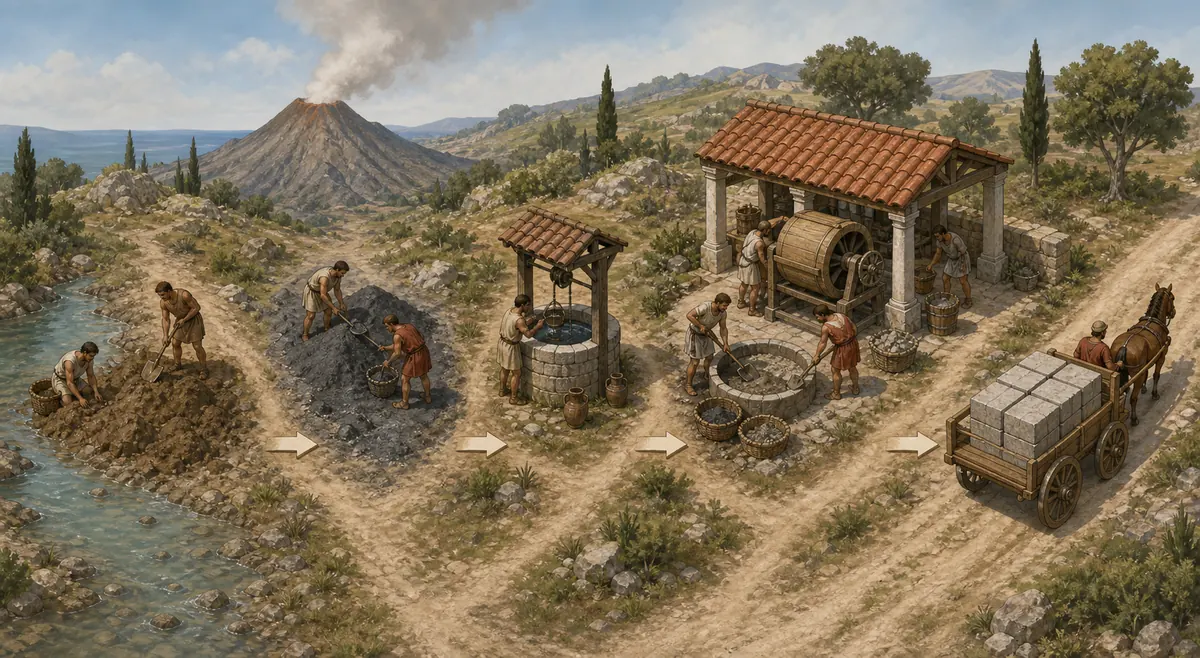
Concrete is a processed construction material, not a resource collected directly from the ground. The current community-documented recipe uses two clay and two volcanic ash in the Concrete Mixer, while the building also needs water. Exact cycle time and throughput can change during Early Access, so verify patch-sensitive values in the live game.
For a controlled first test, place the mixer near a well and a small storage point, deliver both dry inputs, assign a worker, and let one batch finish before expanding. This reveals whether the real problem is recipe knowledge, water access, staffing, hauling distance, or output storage.
Do not queue a town-wide road conversion immediately. Confirm finished concrete leaves the building, keep a volcanic ash reserve, and only then commit to larger road, wall, or workshop upgrades.
| Input | Practical source | First check |
|---|---|---|
| Clay | Clay deposits, often near water | Is it stored near the mixer? |
| Volcanic ash | Volcano or volcanic area | Is the route safe and staffed? |
| Water | Nearby well | Can the mixer receive water? |
| Labor | Assigned worker and haulers | Are other priorities stealing them? |
How to unlock and place the Concrete Mixer
The Concrete Mixer is a mid-game production building. If it is missing from the construction menu, continue the relevant technology and settlement progression instead of stockpiling inputs with no way to process them.
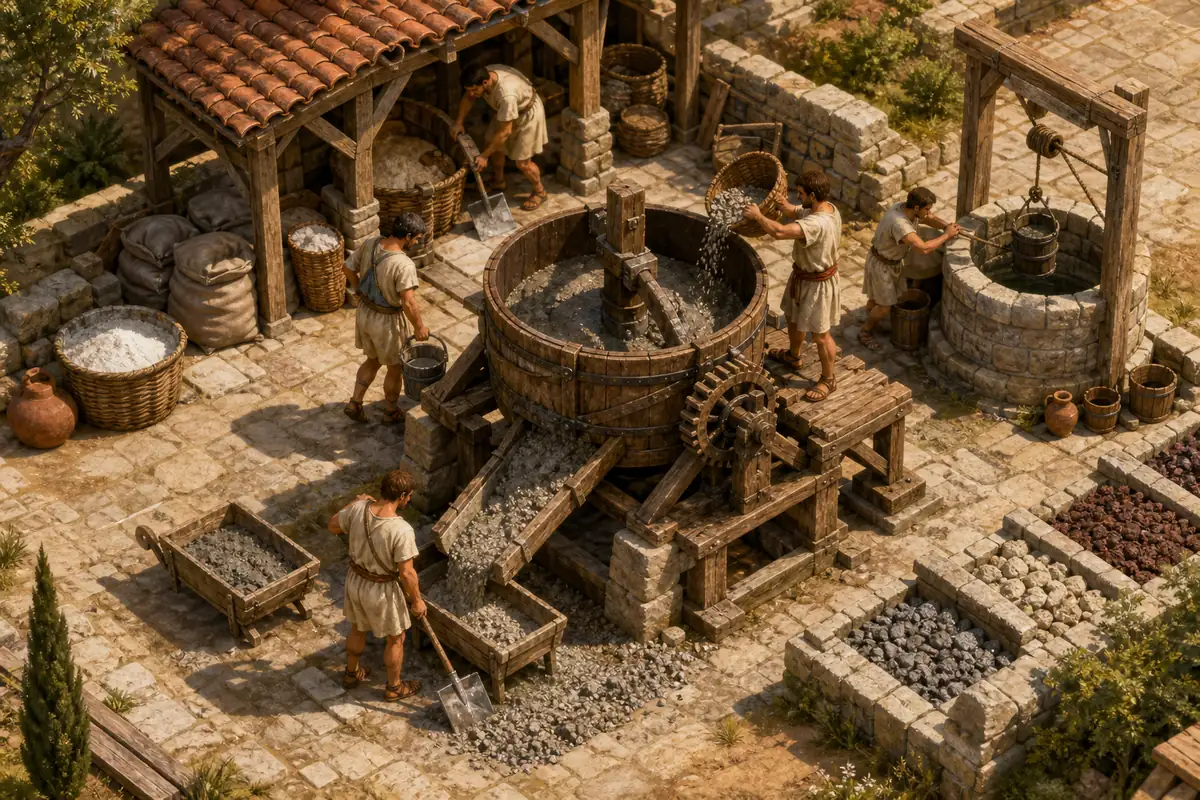
Placement matters more than cosmetic symmetry. A mixer beside the well and input storage avoids repeated walking, while a remote mixer can look fully supplied on paper and still produce slowly.
Leave clear access around the building. Workers must reach the mixer, haulers must deliver clay and ash, and finished concrete must leave before local storage fills.
Clay, volcanic ash, water, and logistics
Clay is usually the easier input once a dependable deposit is identified. A small buffer beside production is more useful than a huge stockpile across the settlement because every long trip reduces mixer uptime.
Volcanic ash is the strategic bottleneck because it comes from a dangerous volcanic region. Plan food, carrying capacity, and a safe return route. Procedural or varied worlds also make fixed coordinates from another save unreliable.
Water should come from a nearby well. Player reports describe the worker carrying roughly four units of water before starting a cycle, so distance to the well can dominate production time even when clay and ash are abundant.
| Bottleneck | Visible symptom | Best first fix |
|---|---|---|
| No volcanic ash | Mixer waits with clay present | Create a dedicated ash route |
| Well too far | Worker walks repeatedly | Build a closer well |
| No local storage | Inputs exist but arrive late | Add a small production buffer |
| Full output | Mixer stops after one batch | Free storage and hauling capacity |
How to automate concrete without hidden bottlenecks
Automation starts with a compact production cell: well, mixer, input storage, output storage, and short paths. Add enough labor to keep each link moving, but do not solve every delay by adding villagers when walking distance is the real problem.
Separate extraction from processing. An empty buffer points to weak collection; a full buffer beside an idle mixer points to water, worker assignment, output storage, access, or priority settings.
Scale one mixer only after it runs consistently. A second mixer doubles demand for clay, volcanic ash, water, hauling, and storage; it does not automatically double useful output.
Concrete roads, buildings, and upgrade priorities
Concrete can support durable construction and road upgrades, but roads are a logistics investment rather than a decorative finish. Upgrade the routes used most often between housing, storage, production, defense, and the town core.
A useful early order is the mixer access path, the route between central storage and workshops, and the path villagers use during defense or repair. Remote low-traffic roads can wait.
Community discussion indicates direct road upgrades may be possible in some contexts, but a phased route protects the volcanic ash reserve and makes production limits easier to see.

Why the Concrete Mixer stops
When the mixer is idle, inspect the entire chain before rebuilding it. Check building access, worker assignment, both dry inputs, nearby water, output storage, hauling priorities, and whether construction or defense is pulling labor away.
Pause large projects and observe one cycle. Long walking points to placement; inputs beside an idle mixer point to water or assignment; finished concrete remaining inside points to blocked output.
| Problem | Likely cause | Action |
|---|---|---|
| No recipe starts | Missing input or water | Verify clay, ash, well, and worker |
| Very slow cycles | Long hauling path | Move storage and well closer |
| Stops after one batch | Output cannot leave | Add storage or hauler capacity |
| Works intermittently | Priority or labor conflict | Reduce competing jobs temporarily |
Version freshness and source safety
This guide was checked on July 19, 2026. The latest clearly named public-branch hotfix found in first-party Steam announcements remains 0.25.1_12. A July 1 post references 0.25.2_4 as a public beta, which should not be treated as the stable public branch by default.
Romestead is update-sensitive. Confirm the live Steam announcements and in-game recipe before spending a rare volcanic ash reserve, especially after a patch changes buildings, logistics, roads, or technology.
Romestead.blog is an independent fan guide. It does not provide game files or unofficial downloads; use the official Steam page for purchase, installation, and current update information.
First production checklist
| Step | Action | Use it when |
|---|---|---|
| 1 | Unlock and build the Concrete Mixer. | Before scaling |
| 2 | Store clay and volcanic ash near it. | Before scaling |
| 3 | Place a well within a short route. | Before scaling |
| 4 | Assign a worker and preserve hauling capacity. | Before scaling |
| 5 | Finish one test batch before scaling. | Before scaling |
| 6 | Keep a reserve before upgrading roads. | Before scaling |
Romestead concrete FAQ
Sources and verification
- Romestead on Steam - Official store and update entry point.
- Concrete Mixer - Romestead Wiki - Community wiki building reference.
- Volcanic Ash - Romestead Wiki - Community wiki source reference.
- Steam Community concrete discussion - Community report documenting recipe and water behavior.